
Early-stage founders can publish useful content about buyer problems, product decisions and honest demonstrations. You do not need invented customer stories or inflated results to explain why the work matters.
Use the questions you can answer well
Make a list of questions from discovery calls, onboarding conversations or your own experience of the problem. Choose the ones that affect a buyer's decision. Avoid presenting a personal hunch as evidence that an entire market behaves the same way.
A strong early post can explain why one workflow is confusing, compare two ways to approach it or show how to evaluate a trade-off. The value is in the explanation. It does not require claiming that your product is already the category winner.
Show a small piece of the product honestly
Choose a working path and describe exactly what it does today. Label prototypes, sample data and incomplete integrations. A focused example makes it easier for a reader to understand the product than a list of every future capability.
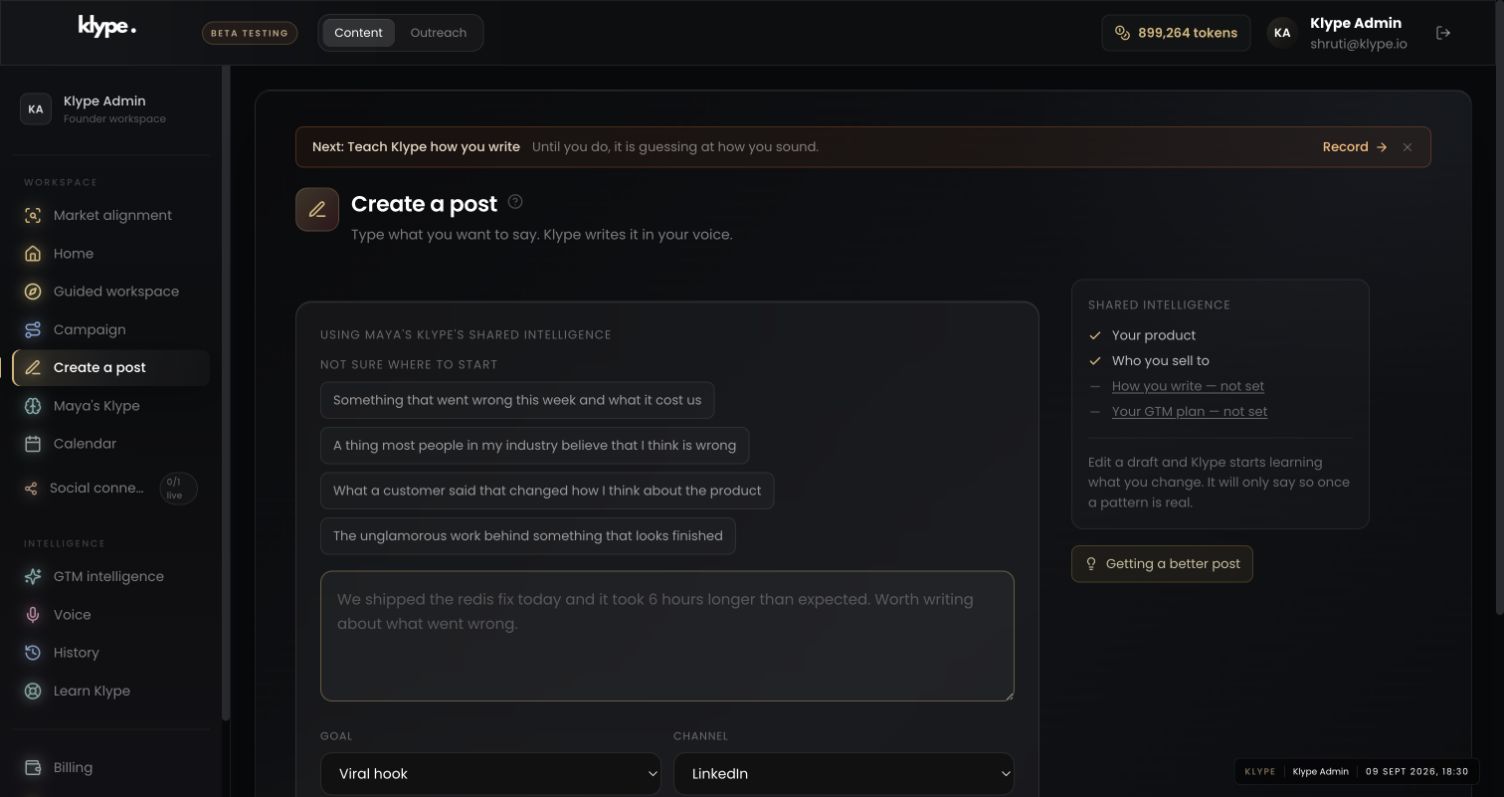
If you show a screenshot, include enough context to distinguish a test workspace from a customer result. Avoid using an internal admin balance, a synthetic record or a mock dashboard as evidence of adoption or commercial performance.
Build a balanced first batch
Draft one explanation of the buyer problem, one product decision, one practical checklist and one demonstration. This is an editorial starting point, not a universal optimal posting frequency. Match the pace to what you can review and support.
Give each item a different next step. Some readers need a useful question to ask; others may be ready to view the product. Repeating a booking link under every observation makes the whole sequence feel interchangeable.
Learn from the right feedback
Record objections, misunderstandings and questions that recur. A post that prompts two relevant conversations may teach you more than a broadly popular opinion. Keep commercial conclusions proportional to the amount of evidence.
Klype's business context and drafting workflow can support this routine. Save accurate product information and revise it as the product changes. No content platform can substitute for verifying that the feature you describe is actually available.
Common questions
Can I publish before having paying customers?
Yes. Share useful reasoning, demonstrations and observations while being clear about the stage of the business.
Should I call every feature proprietary?
No. Describe what it does and why it helps. Claims about ownership or superiority should be supported, not used as decoration.
Choose your way of working
Want a team to help with strategy, editing and distribution? Talk to Wise Mango, Inc.. Prefer to manage your business context and content yourself? Explore Klype AI. Check the platform's current features and subscription terms before joining.

Founder of Klype. Writing about clear business communication, useful content and practical distribution.
Connect on LinkedIn ↗